Lessons from a Poisoned Creek
Here I am, starting a blog as if I have nothing better to do with my precious spare time. Not because I believe I’m especially wise or unique, or because I’m trying to build some kind of soapbox to stand on and preach from. Its kind of an older style of content, so I do wonder if it will be of interest to others, especially in an age where Tik Tok and sound bytes are the most commonly consumed media. But Youtube and Instagram aren’t great places for a lot of thoughts like what I want to share. Oh, and I need an outlet pretty bad. My wife, bless her, can only handle so much of my musings.
I spend a lot of time reading, listening to books, wandering in the mountains, and thinking about why things are the way they are: ecology, psychology, health, stress, spirituality, the strange line that seems blurred where human behavior ends and the natural world begins. Writing gives me a way to sort through all of that. It feels like a good way to clarify my thoughts.
So this first post is an experiment. It’s an invitation and an introspection. And it begins in a valley at 10,000 feet where I found a spring that runs red.
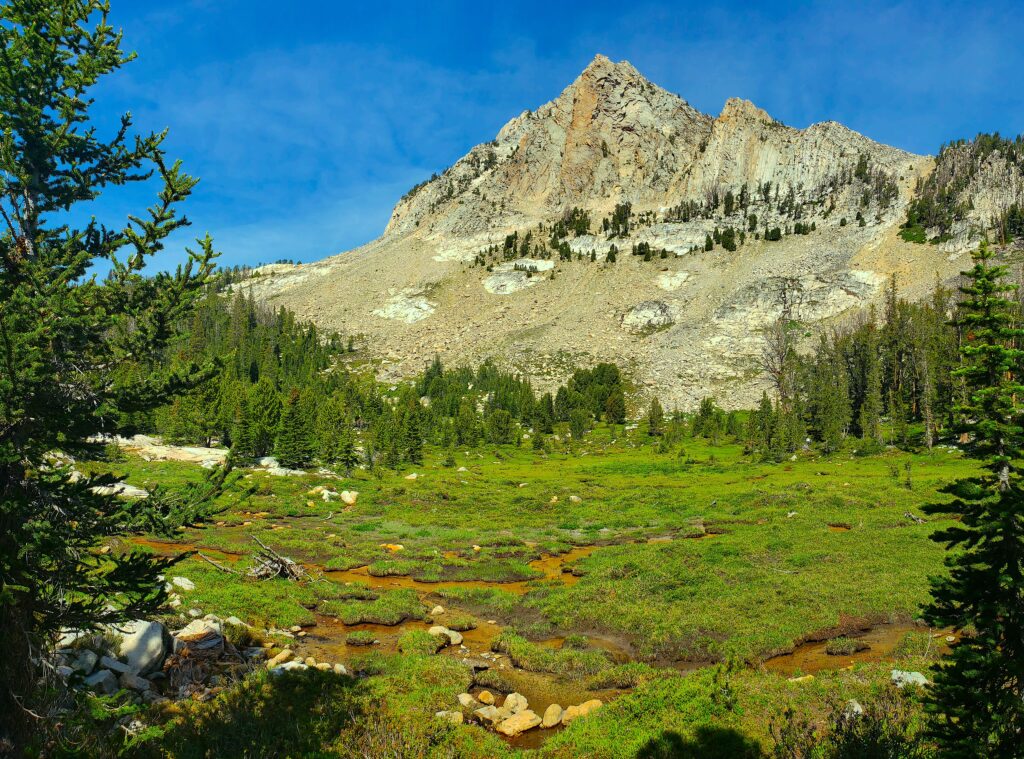
“Hidden Valley,” looking North.
The Hidden Valley
I resonate with the symbols found across religion and spirituality, especially the idea that the high mountains are a place to connect with the spiritual. I often experience profound spiritual experiences there, typically as quiet, visceral, and grounding moments. Since I was young, I’ve felt that pull toward nature in a way I can’t fully explain. Studying ecology, working in the field, bowhunting, fly fishing, backpacking, have all been my attempts of trying to get closer to that feeling.
But not long ago, I found myself carrying a kind of burnout I hadn’t thought possible: outdoors burnout. Not burnout from the mountains, but from people, career, complexity, expectations, and the sense that my mind was stuck somewhere I couldn’t escape. I kept trying to “reset” by going outside, but I felt like I was just bringing the whole mess with me and sullying the good I found there.
And then, on an off-trail backpacking trip with my cousin Kaleb, I stumbled into a place that changed how I think about life.
We had spent the night in hammocks after several miles beating our own trail to a remote lake high in the White Cloud mountains of Idaho, eating cutthroat trout over a small fire and slapping the mosquitos until the wind finally chilled us into a few hours of uneasy sleep. The next morning, we skirted the treeline—dodging July snowdrifts, rolling boulders down steep faces just to hear them smash into the trees below, and soaking in the kind of mountain views that make you feel temporary and small.
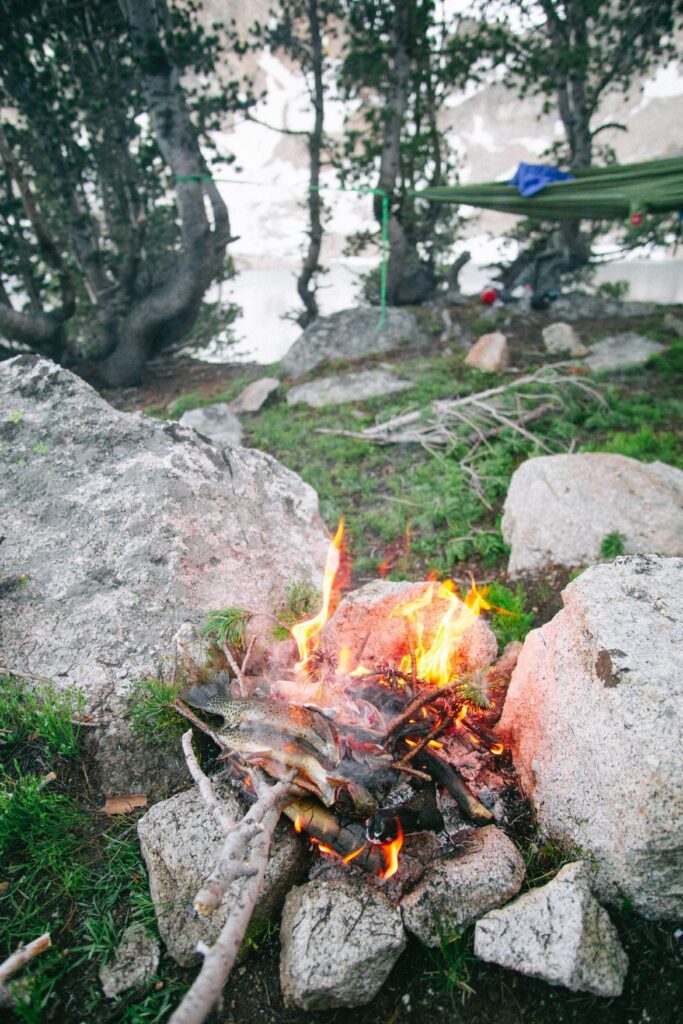
Cutthroat trout on the fire for dinner, first night.
By midday we dropped 800 feet of elevation into a hidden valley cut off from the main trail we planned to link up with the next day by a massive ridge. From above we could see a beautiful meadow ringed with springs on its North side. The whole thing looking like a place anyone might dream about. And we were thirsty. We figured we’d refill our bottles, hike up to fish at another lake, and come back to camp among the meadow grasses.
But when we reached the springs, something was off. The cobbles in the creek bed were stained red, and where the water pooled, an iridescent slick clung to the surface like oil.
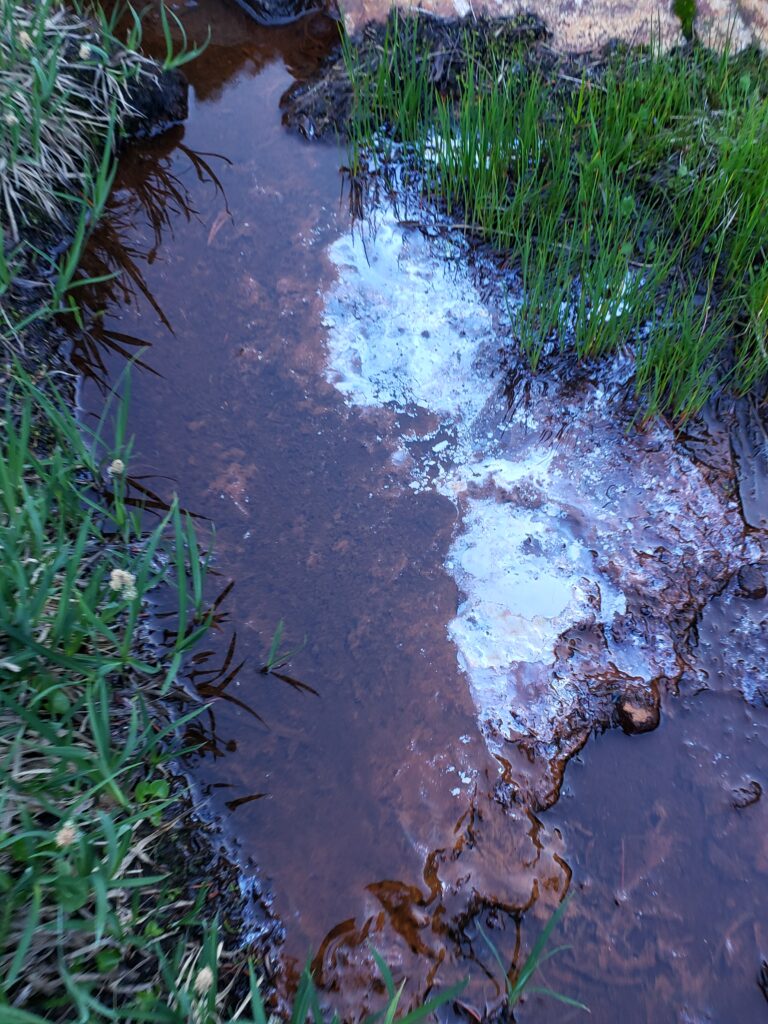
Metal slick in the spring.
There were no signs of people—no footprints, trash, or trails. Just pikas calling from the rocks and a few fresh elk tracks. But the water was clearly sick. I knew enough to trust that instinct. We left the valley and climbed back toward snowmelt and fishable lakes, our throats dry and our bottles still empty.
We filtered water high on the next ridge, moved to another lake to fish, and returned later that evening, only to discover we had picked a place to camp with a mosquito swarm unlike anything either of us had ever seen. They coated our backs, arms, faces, everything. Hundreds at a time. With no bug spray, we built a smoky fire and stood in its fumes for hours, taking turns running out to the dead branches nearby to feed the fire to keep the swarm at bay.
But after sunset, the wind shifted and the valley calmed. The mosquitos thinned. The meadow glowed. The stars came out. We resorted to eating dinner and lounging by the fire. (Kaleb took the opportunity to take some awesome night photos, he is a professional photographer and took all the pictures in this blog.)
I stretched out beside the fire, exhausted and grateful for the relief from the mosquitos. And in that moment, surrounded by beauty and misery at the same time, I realized something: I was still looking at life wrong.
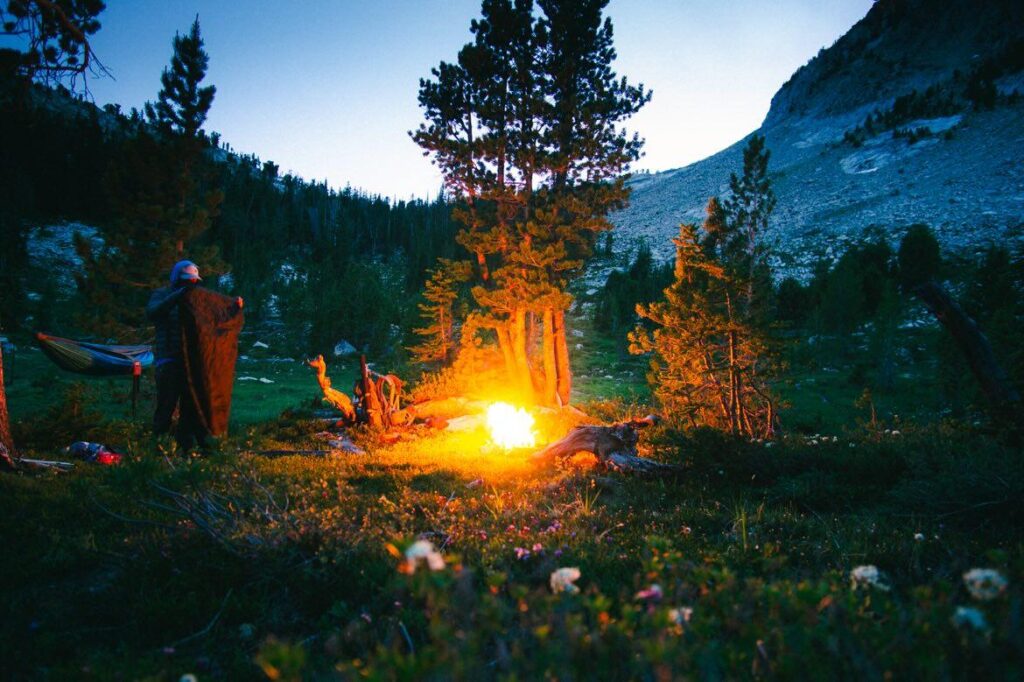
Evening in hidden valley, after the mosquitos started thinning.
The Creeks We Drink From
Lying next to the fire, I realized the red, unnamed creek bubbling by was symbolic to me. It isn’t a new concept, but I felt that nature was reminding me that its beauty and its harshness aren’t opposites. They’re inseparable and obligates of each other. You can’t separate the gorgeous sunrise from the life-sucking mosquitoes or the clear or even the life-sustaining water from its potentially hidden toxins.
The more I thought about that creek, the more I realized how much of life works the same way.
Every one of us is shaped by the “water” we’ve been drinking—our environments, families, jobs, relationships, habits, traumas, victories, failures. Some of it is nourishing. Some is toxic. Most is a mix. And often, you don’t realize what you’ve been absorbing until you find its effects in your body or mind years later.
When I got home, I researched the valley and learned the metallic slick and strange tint was almost certainly antimony, a metal common in some of Idaho’s mineral-rich mountain ranges. If I had filled my bottle in that creek, even if it was farther downstream (where the water looked clean) I would’ve still ingested small amounts of it and suffered its effects.
Even though this was now three years ago, it has stuck with me as a profound personal lesson.
Some of our “toxins” in life are subtle, cumulative, and unseen. Often, you don’t know you’ve partaken of it. Others have immediate and life changing effects.
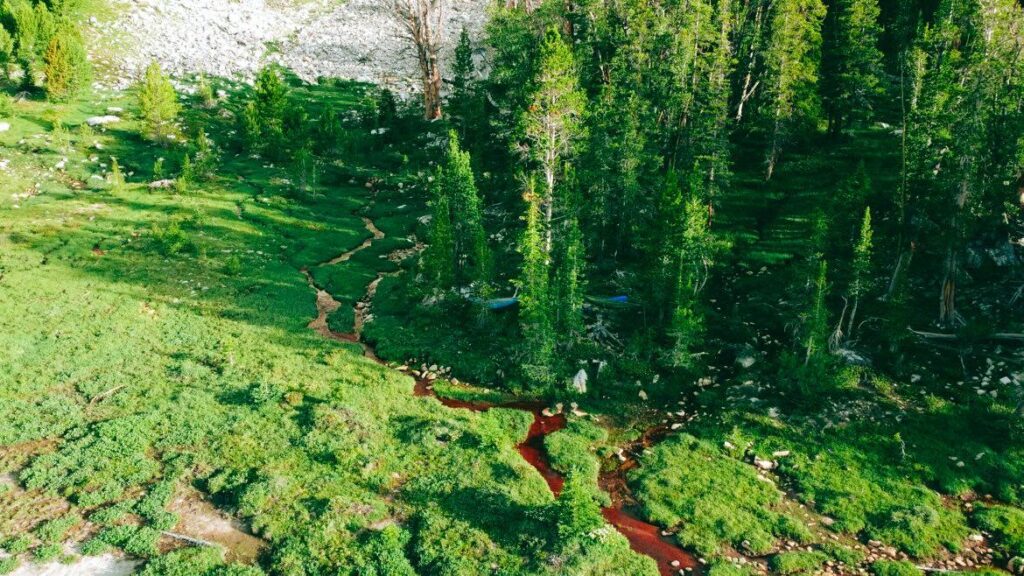
“Antimony Creek,” with our camp in the stand of trees on photo right.
Coevolution, Bottlenecks, and Becoming Something New
There’s an ecological concept that I don’t think people talk about enough: what happens when two species encounter each other for the first time. We tend to imagine invasives as agents of mass extinction or “bad”, but the research paints a different picture. Extinction from invasion is actually rare. What usually happens instead is a bottleneck—a period where impacted species become stressed, outcompeted, and the system is forced to adapt.
And then, on the other side of that pressure, ecosystems often emerge more energy-efficient, more biodvierse, more fine-tuned, and more resilient. New species may even arise out of it.
It’s chaotic and uncomfortable, but it’s also how nature evolves. Pressures create change. Exposure creates adaptation. New interactions create entirely new forms of life.
And humans?
We are both unwittingly engineering that across ecosystems worldwide today. If you believe we are a part of this system, inseparably like I do, you might feel like I do that we are nature’s next step in evolution of creating an even more “perfected” system. Not only that, we undergo the same thing through our experiences in every way: emotionally, psychologically, socially.
Meeting someone new, leaving a toxic environment, becoming a parent, losing a friend, growing up in a stressful home, entering a new culture, reading a life-altering book, absorbing someone’s pain, inheriting someone’s habits… each of these moments pushes us through a kind of coevolution bottleneck.
From this, we harden in some places and soften in others. We learn new ways of using our “energy.” We become a new version of ourselves—sometimes subtly, sometimes drastically. Sometimes, these versions and traits can be maladaptive, and we further devolve into unproductive organisms for the whole.
Here’s the part that feels different about being human:
We still get to choose in the little moments.
Not completely and definitely not perfectly. But the moment we become aware of what we’re drinking, we gain the ability to change it. To seek cleaner water. To stop absorbing someone else’s poison. To stop feeding ourselves our own. To build systems and habits inside us and around us that aren’t just for survival, but for meaning.
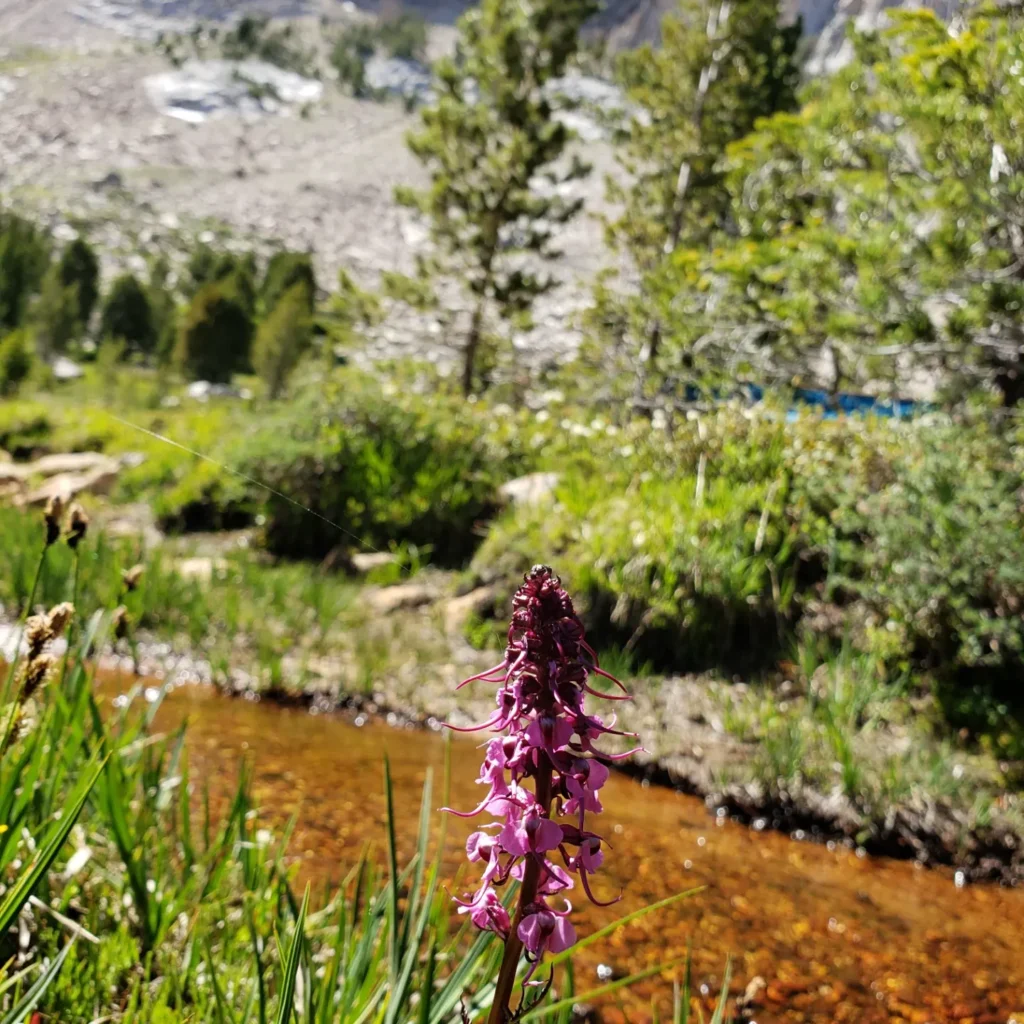
A beautiful Elephant-Head flower growing next to “Antimony Creek”
This blog is part of that choice for me. I am choosing to view it all as a process, not as “good” or “bad.”
This will be a way of pausing, reflecting, distilling, and staying awake to the things that shape me. A way of documenting the ecosystems I’m trying to build through nature, curiosity, health, philosophy, and the messy, beautiful reality of being a dad, a student, a creator, and a person trying to move forward in spite of the poison I’ve already consumed and the poison I will inevitably find in the future.
I’m not writing because I think I have answers.
I’m writing because I’m trying.
If any of this connects with you, I’m glad you’re here.
Maybe we’re drinking from the same creek (for better or worse!)
Jared
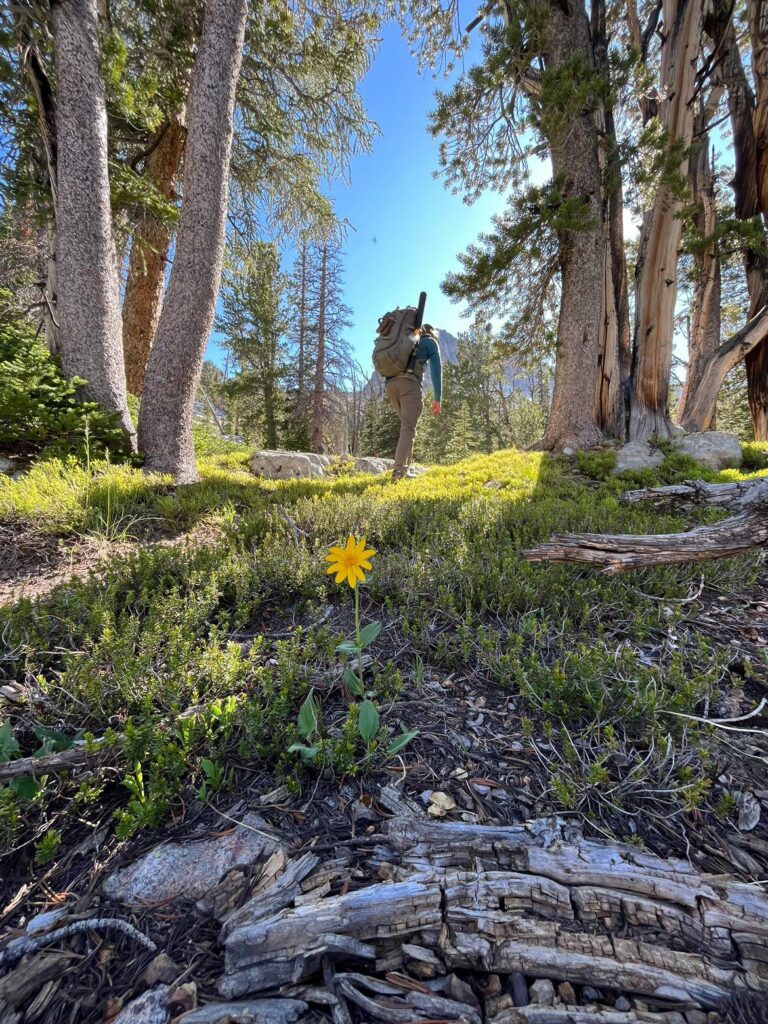
An Arnica flower takes center stage as I face the trail-less walk up to the lake.
After watching a couple of your rockhounding videos, I came across your website, and then your blog. I find your article of the poisened creek, and the lessons learned to be very interesting and insitefull. In particular, your view of us humans and our place in the greater earth. Many people decry the effects of people on the planet. They are not completely wrong, but I think they miss some critical points. I think that many people miss out on what our role should be. A term that comes to mind for me is “stewardship”. We should care for our surroundings. There are resources to be used for our benefit. There is also the nature to enjoy in so many ways. That’s enough of what could be a long essay, but I did enjoy your essay.
Thank you for sharing your thoughts Paul! Yes, if we are inseparable with the system and a product of it through evolution, that means that we are the master ecosystem engineers. And we should treat ourselves as such. I do think there will be many unintentional long-term benefits to what we perceive as negative or bad right now. For example, all the species we consider invasive now will eventually become integrated and develop new relationships in the evolutionary timeline, leading to new mutualistic relationships, adaptations, and diversity. So even unintentionally, we have likely caused both “beneficial” and “detrimental” impacts to the system, and likely in equal parts, especially at scale. Stewardship is ethically crucial, but in my experience, stewardship is still focused on humans trying to keep things the same because they fear change, not necessarily because they are trying to help a system optimize. So I guess I support stewardship for the right reasons, because that drives better decisions! You are right, that could be an essay in and of itself. Thanks again for your comment!